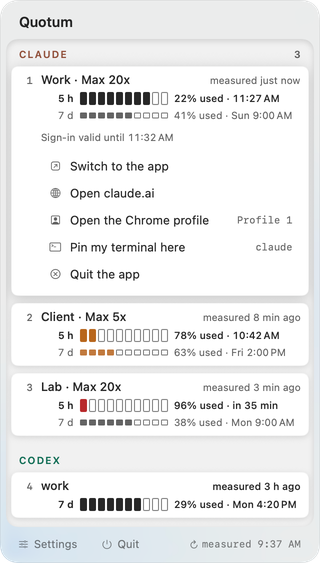
Several free apps show your Claude and Codex usage. Quotum costs €4.99, once, for two things: it opens the account that still has room, and it writes nothing to your tools' sign-ins. Surveyed on , sourced cell by cell.
In short: which one to pick
Pick Quotum if you move between Claude or Codex accounts and want to open the right one in one gesture, with no third-party tool in your sign-ins.
Pick CodexBar or OpenUsage for a free, open-source tool; CodexBar tracks far more tools, from macOS 14.
Pick SessionWatcher if you also work on Windows.
Pick Claude Usage Tracker or Cockpit Tools for a tool that switches accounts for you.
macOS 26 or later, Apple Silicon or Intel · fourteen-day trial on the first two lines of the panel · €9.99 after the launch · activation on up to three new Macs a year
What €4.99 buys
The right account, in one gesture. Quotum opens a Claude or Codex account's app, its website in its Chrome profile, or a terminal pinned to it; none of the five others announces a profile per account.
Switch to the appWork
Open the Chrome profileWork
Pin my terminal hereWork
Diagram: only the panel is a screenshot.
Your sign-ins stay as they are, and nothing is tracked by default. Quotum reads them without writing any, or a key you paste for Z.ai and MiniMax; so it does not switch the active account, where others rewrite Codex's auth.json or Claude Code's sign-in.
On your Mac
your tools' sign-ins
reads
Quotum
asks for the quota
Each tracked tool
its server or its CLI; JetBrains AI: a file
Writes no sign-in
Reads no cookie in your browser
Three exceptions
Codex: a reset spent on your order.
Muse Code: a key created at Meta at each measurement, every fifteen minutes at most.
Codex signed in with a personal access token: two requests presented as the official CLI.
Read at each measurement, tracked or not
~/.claude.json
local proxy addresses
~/Applications and Chrome's Local State
ps -axo command
the usage history Claude Code writes itself
the end of the Codex CLI session logs, that is, the transcripts of your sessions
One price, once. No subscription, professional use allowed.
Six questions to ask before you install
A check mark means “good for you”.
Question
Quotum
CodexBar
SessionWatcher
OpenUsage
Cockpit Tools
Claude Usage Tracker
Does it open the account it measures?
Yes: app, Chrome profile, terminal
Not announced
Not announced
Not announced
Yes: app instances, terminal
Yes: terminal per profile
Does it leave your sign-ins untouched?
Yes: writes none
No: rewrites Codex's
Says it reads them
Yes: reads none
No: Codex's and Grok's
No: Claude Code's
Does it introduce itself under its own name?
Yes: except one Codex case
To OpenAI only
Not established
No
No
No
Does it wait for your choice?
Yes: nothing by default
No: Codex by default
No: the tools it finds
Yes: each account is added
Not stated
No: Claude, if signed in
Is it free?
No: €4.99 once
Yes: MIT
No: $8.99 to $79
Yes: MIT
Yes: non-commercial use
Yes: MIT
How many tools, on which Mac?
25, macOS 26
113, macOS 14
22 with Pro, macOS 14, Windows
13, macOS 15
17, Windows, Linux
2, macOS 13
Where the others do more
Free and open source. CodexBar, OpenUsage and Claude Usage Tracker, under MIT. Quotum publishes only the part of its code that touches your sign-ins, read-only.
More tools. CodexBar lists 113, ClaudeBar 31, Quotum 25.
An older Mac, or another system. macOS 13 is enough for Claude Usage Tracker, 14 for CodexBar and SessionWatcher; Windows: SessionWatcher, Cockpit Tools. Quotum needs macOS 26.
Switching accounts for you. CodexBar for Codex, Cockpit Tools, Claude Usage Tracker. Quotum changes no tool's active account.
Estimated costs, a long history. CodexBar, SessionWatcher Pro, Claude Usage Tracker, ccusage on the command line. Quotum shows the spend published by Claude, Codex, Cursor, Grok, GitHub Copilot and Kiro (usage credits, on-demand spend, prepaid balances), AWS and Azure budgets, a desktop widget, and twelve weeks of Codex usage. It does not estimate costs from local logs.
Head to head
CodexBar vs Quotum
CodexBar tracks more tools, for free; Quotum opens the measured account and leaves your sign-ins alone.
SessionWatcher also runs on Windows; Quotum tracks more tools, several accounts included, for €4.99.
Criterion
Quotum
SessionWatcher
Several accounts
€4.99 once
Pro: $79, or $24 a year
Opens the measured account
App, Chrome profile, terminal
Not announced
Other systems
Mac only
Windows; iPhone and Apple Watch in beta
Where Quotum does more
Tracks 13 tools that SessionWatcher does not list, Warp, Codebuff and Augment among them.
Where SessionWatcher does more
90 days of history with Pro.
DeepSeek, Mistral, OpenRouter.
OpenUsage vs Quotum
OpenUsage is free, open source, and reads none of your tools' sign-ins; Quotum tracks almost twice as many tools, with nothing to sign in again.
Criterion
Quotum
OpenUsage
Price
€4.99 once
Free
Tools tracked
25
13
Usage data sent
None from the app
Daily ping and crash reports; account count, can be turned off
Where Quotum does more
Tracks 13 tools that OpenUsage does not list, Warp, Codebuff and Augment among them.
Where OpenUsage does more
Free, open source (MIT).
Several accounts for every tool, from macOS 15.
Cockpit Tools vs Quotum
Cockpit Tools runs on Windows and Linux and switches accounts for you; Quotum allows professional use.
Criterion
Quotum
Cockpit Tools
License
Professional use allowed
Non-commercial use
Writes to your sign-ins
No
Yes: Codex's and Grok's auth.json
Other systems
Mac only
Windows, Linux
Where Quotum does more
Tracks 14 tools that Cockpit Tools does not list, Warp, Codebuff and Augment among them.
Opens the website in each Claude or Codex account's Chrome profile.
Where Cockpit Tools does more
Switches the active account, on its own if you wish.
Isolated app instances per account.
Claude Usage Tracker vs Quotum
Claude Usage Tracker is free and switches Claude Code's account for you; Quotum tracks twenty-three tools beyond Claude and Codex.
Criterion
Quotum
Claude Usage Tracker
Price
€4.99 once
Free
Tools tracked
25
2
Writes to your sign-ins
No
Yes: Claude Code's
Where Quotum does more
Opens the account's app and Chrome profile.
Sends no usage data from the app.
Where Claude Usage Tracker does more
Free (MIT), from macOS 13.
Switches the active account, on its own if you wish.
Try it for fourteen days
The trial covers the first two lines of the panel. Ten versions since September 25, all in the changelog; a purchase is refunded on simple request for thirty days.
macOS 26 or later, Apple Silicon or Intel · fourteen-day trial on the first two lines of the panel · €9.99 after the launch · activation on up to three new Macs a year. Read the warning on Pricing before you buy.
Every criterion, for the six tools
Surveyed on ; every cell links to its source. These tools change often.
Announced Not announced, not stated or not verified No
Criterion
Quotum
CodexBar
SessionWatcher
OpenUsage
Cockpit Tools
Claude Usage Tracker
See where every account stands
Several accounts for the same tool
Yes for Claude, Codex, Cursor, Devin Desktop (formerly Windsurf)¹ [1]
Yes: Codex's auth.json, when it switches the system account ()[42]
Says it reads them read-only; closed source, not verified ()[4]
No: reads and writes no other tool's sign-in, according to its documentation and code ()[31][25]
Yes: Codex's auth.json and Grok CLI's, when it switches accounts ()[43][44]
Yes: Claude Code's sign-in, in the Keychain and in ~/.claude/.credentials.json, and the account written in ~/.claude.json, when you switch profiles ()[45][46]
Presents itself as an official client
No, except the two requests of a Codex account signed in with a personal access token, presented as the Codex CLI ()[1]
Yes: claude-cli/… (external, cli), then claude-code/… on a retry, toward Anthropic; “CodexBar” toward OpenAI, originator “Codex Desktop” for reset credits ()[47][48][49]
Yes: claude-cli/… (external, cli) toward Anthropic; originator “Codex Desktop” to redeem a Codex reset, its usage reads saying “OpenUsage”; GitHubCopilotChat/0.26.7 toward GitHub ()[50][51][52]
Yes: originator “Codex Desktop” and user agent Codex Desktop/… for the Codex quota; codex-tui/… for local access ()[53][54][55]
Yes: claude-code/2.1.5 with Claude Code's sign-in; Safari user agent and claude.ai origin with a session key ()[56]
Sends usage data of its own
None in the app; the website counts its visits (Cloudflare Web Analytics) ()[1][57]
No analytics library among its dependencies ()[58]
Yes: about once an hour, with the update check, an install identifier, the license age and the steps from trial to purchase, unless automatic updates are off; the trial sends a device identifier ()[59]
Yes: a daily ping and crash reports, not optional; a count of accounts per tool, on by default and can be turned off (PostHog) ()[60][61]
No analytics library found; loads a remote configuration and announcements from GitHub ()[62][63][64]
Yes: one anonymous ping a day, at launch, with no setting to turn it off; one anonymous count when you tap “Notify Me” ()[65][66][67][68]
Interface languages
23; release notes in English and French, shown in English in the other 21 languages ()[36]
¹ Quotum handles several accounts for 4 of its 25 tools: Claude, Codex, Cursor and Devin Desktop (formerly Windsurf); the other twenty-one have one line each.
² Through an account app that Quotum creates.
³ Chrome profile named after the account; Google Chrome only.
⁴ Matched by the names each publisher lists. Of the five other tools in the table, CodexBar covers all twenty-five; SessionWatcher lists eleven of them for certain, OpenUsage twelve, Cockpit Tools eleven and Claude Usage Tracker two. Nothing establishes that SessionWatcher's “Devin” is Devin Desktop. Grok Bot is shown within Cursor at OpenUsage and CodexBar.
Three more trackers, on the same four questions
Quotio, ClaudeBar (31 tools announced[96]) and AIQuota, read in their code on .
Criterion
Quotio
ClaudeBar
AIQuota
Rewrites other tools' sign-ins
Yes in 0.33.1, its latest stable release: Codex's auth.json and config.toml, when it points Codex at its proxy; the 1.0 betas read that auth.json without writing it ()[73][74][75]
Yes: Claude and Codex sign-in files and Claude Code's Keychain item, after a refresh ()[76]
None found in its code; it writes only to its own Keychain item ()[77]
Presents itself as an official client
Yes: claude-code/2.1.69 in 0.33.1, claude-code/2.1.0 in its CLI; originator “Codex Desktop” ()[97][78][79]
Yes: the OAuth client IDs of Claude Code and Codex; user agent “OpenUsage” toward ChatGPT, “ClaudeBar” toward Anthropic ()[80][81]
Yes: claude-code/2.1.0; ChatGPT requests dressed as its web page ()[82][83]
Sends usage data of its own
PostHog in 0.33.1, off by default; absent from the 1.0 betas and its main branch ()[98][84][85]
No analytics library among its dependencies ()[86]
On , we read each tool's repository at a dated commit (CodexBar 5bebf9a, OpenUsage 4152e02, Cockpit Tools 22eb4df, Claude Usage Tracker 4ba1fd4, Quotio 2b00774 and its stable release 0.33.1, ClaudeBar 14c2423, AIQuota 0efc606), then its publisher's page. SessionWatcher does not publish its code: its cells rest on its website, its privacy policy and its update feed. None of these apps was run.
“Not announced”: absent from the publisher's public documentation, which does not prove the feature is missing. “Not stated”: the documentation does not answer. “Not verified”: not established; the cell keeps the date of its survey. Prices are each publisher's, in its own currency. Report a fact that has changed to contact@quotum.app.
Outside the table, ccusage is a command-line tool of another kind: it reads the local logs of twenty coding CLIs and turns them into token and estimated cost reports; its README announces neither a menu bar nor multiple accounts[92].
All names belong to their owners; Quotum is not affiliated with any of them.