Quotum and Quotio compared
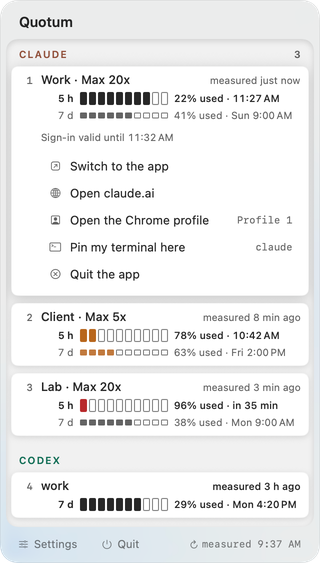
Quotio is free, open source, and runs a local proxy that your coding agents share: if that is what you need, pick it. Quotum is for people with several Claude or Codex accounts: it shows which one still has room and opens it in one gesture, with no proxy and no rewritten sign-in.
Quotio checked on , in its README and code: release 0.33.1 and its main branch. We did not run Quotio; its repository is the reference.
What Quotio does best
- It is free and open source, under the MIT license, installed with
brew install --cask nguyenphutrong/tap/quotio. - It runs a local proxy, CLIProxyAPI, and its stable release can point Claude Code, Codex CLI, Amp, OpenCode and Factory Droid at it.
- It reaches beyond the Mac: a command-line tool, also on Linux x64, and an iPhone companion in its repository.
- It runs on macOS 14 or later. Its latest stable release, 0.33.1, dates from ; the latest 1.0 beta, from .
What Quotum adds
- The account it measures, opened. On a Claude or Codex account set up with its own app copy or Chrome profile, Quotum opens that copy, claude.ai or chatgpt.com in that profile, or a terminal pinned to it.
- Your sign-ins left as they are. Quotum reads the sign-ins other tools keep and writes none.
- Requests under its own name. Quotum's one exception: the two requests of a Codex account signed in with a personal access token.
- Twenty-five tools, twenty-three languages, with nothing tracked until you choose.
Side by side
| Criterion | Quotum | Quotio |
|---|---|---|
| Opens the account it measures | Yes, for Claude and Codex accounts set up in it: app, Chrome profile, terminal | Not announced |
| Local proxy for coding agents | No | Yes, CLIProxyAPI |
| Source code | Partly published, read-only | Open, MIT |
| Leaves other tools' sign-ins as they are | Yes: reads them, writes none () [3] | No, in 0.33.1: writes Codex's |
| Uses its own name toward the servers | Yes, except the two requests of a Codex account signed in with a personal access token, presented as the Codex CLI () [3] | No, in 0.33.1: |
| Sends no usage data of its own | None from the app; the website counts its visits (Cloudflare Web Analytics) () [3][8] | None unless you opt in: 0.33.1 embeds PostHog, off by default; absent from the 1.0 betas () [9][10] |
| Interface languages | 23; release notes in English and French, shown in English in the other 21 languages () [11] | 4: English, French, Vietnamese, Simplified Chinese () [12] |
When to pick which
- Pick Quotio if you want it free, want to read the code, want a local proxy shared by your agents, need a command-line tool on Linux x64, or run macOS 14 or 15.
- Pick Quotum if your Mac runs macOS 26 and you juggle several Claude or Codex accounts: it opens the one with room and rewrites no other tool's sign-in.
For macOS 26 or later. Free trial for fourteen days, on the first two lines of the panel. Launch price: €4.99 once, then €9.99; no subscription.
CodexBar, SessionWatcher, OpenUsage, Cockpit Tools and Claude Usage Tracker are compared on Claude and Codex usage trackers for Mac, compared. Quotum is not affiliated with Quotio.
Sources
Show the twelve sources
- Quotio, README at its main branch:
README.md - Quotio, releases 0.33.1 and 1.0.0-beta.11:
v0.33.1,v1.0.0-beta.11 - Quotum, What Quotum reads on your Mac:
quotum.app/what-quotum-reads - Quotio 0.33.1, Codex configuration writes:
CodexAgentConfigurationAdapter.swift - Quotio 1.0.0-beta.11, infrastructure code:
QuotioInfrastructure - Quotio 0.33.1, Claude request headers:
ClaudeQuotaFetcher.swift - Quotio 0.33.1, Codex request headers:
CodexResetCreditInventoryFetcher.swift,CodexProfileAnalyticsFetcher.swift - Quotum, Legal notice (read on October 10, 2026):
quotum.app/legal - Quotio 0.33.1, PostHog, off by default:
UserDefaultsPreferenceRepositories.swift,TelemetryController.swift,Package.swift - Quotio, main branch, dependencies:
Package.swift - Quotum, update feed (read on October 10, 2026):
updates.quotum.app/appcast.xml - Quotio, interface strings:
Localizable.xcstrings
Read on November 17, 2026: main branch at commit 2b00774, release 0.33.1 at commit 72d0060.
FAQ
What is Quotio?
A free, open-source Mac app, under the MIT license, that manages CLIProxyAPI, a local proxy for AI coding agents, and shows the quota of the accounts behind it. It requires macOS 14 or later; its command-line version also runs on Linux x64.
Is there a Quotio alternative?
Several. Quotum is one, for Macs on macOS 26: it tracks twenty-five tools without a proxy and without rewriting their sign-ins, and on a Claude or Codex account set up in it, it opens the right desktop app, Chrome profile or terminal.
Does Quotio change Codex's settings?
Its latest stable release, 0.33.1, does when you ask it to configure Codex for its proxy: it writes Codex's auth.json and config.toml. Its 1.0 betas no longer carry that code. Quotum writes neither.
Does Quotum do everything Quotio does?
No. It runs no proxy, does not configure your agents, has no command-line tool or iPhone app, and requires macOS 26. What it adds is acting on the account it has just measured, and leaving other tools' sign-ins as they are.