Menu bar app for macOS
Your Codex usage, per account, in the menu bar
Codex counts your work in a weekly window, and on some plans a five-hour one too. When the week runs out mid-job, another account may still have room. Quotum shows the Codex windows of each of your ChatGPT accounts in the Mac menu bar, with their reset times when OpenAI gives them, the resets in the bank, and how old each figure is.
Free trial for fourteen days, on the first two lines of the panel. Launch price: €4.99, then €9.99. macOS 26 or later.
The weekly window, and the five-hour one when there is one
Each window gets its own line: a ten-box gauge whose filled boxes show what is left, the share used and, when OpenAI gives it, the time it resets. The shortest window takes the first line, in full boxes; the others follow in flat bands.
An account whose week is used up, measured within the last hour, folds into one line under “Recharging”, with a moon and, when it is known, the time it comes back. It keeps its full row while Codex credits can still pay for the work.
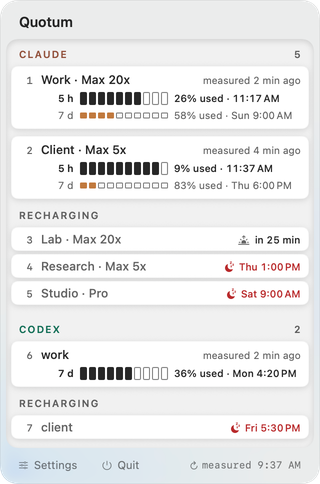
Several ChatGPT accounts, side by side
The Codex dashboard and the CLI show the account you are signed in to. Quotum lists your Codex accounts under one heading, next to Claude Code, Cursor and your other tools:
- The account the Codex CLI is signed in to is measured on request, with
the sign-in the CLI keeps where its
config.tomlsays: in~/.codex/auth.jsonor in the Keychain. - Every other Codex account whose sign-in Quotum can read is measured the
same way, from the
CODEX_HOMEof its account app or the folder a local proxy publishes for it. Its sign-in is read without being rewritten, the same folder only once: two folders that carry the same account are both read. - Other Codex accounts show a figure when one is available, such as their last request's through a local proxy.
- Every figure says how old it is, in a heavier weight past one hour.
Banked resets, shown and spent at the right moment
When a Codex account has resets available, Quotum shows them and can spend one with “Spend a reset”: by hand, after a second confirmation, or without asking if you turn that setting on (off by default). Either way, only once the server has observed the quota exhausted, on a measurement at most ten minutes old: a spent reset is lost. The details: Codex resets.
Then open the right account
Open a Codex account in its own copy of the ChatGPT desktop app or in its Chrome profile, or pin your terminal to it so that the Codex CLI runs on that account. How the accounts stay apart: multiple accounts on one Mac.
Where the figures come from
Quotum reads the sign-in the Codex CLI keeps on your Mac, once you choose to track Codex: nothing is tracked at installation. It also reads the end of the Codex CLI session logs, the transcripts of your sessions, whether Codex is tracked or not; nothing from them leaves your Mac. The full list: What Quotum reads on your Mac.
Read this before you buy. OpenAI does not provide for a third-party app reading Codex's quota with the CLI's sign-in. The risk falls on your account, up to its suspension, and it is set out in full on the pricing page.
Without an app: how to check your Codex usage. Running Claude Code too? Codex vs Claude Code compares their limits.
FAQ
How do I track my Codex usage on a Mac?
Install Quotum and choose Codex in “Choose the tools to track”. The menu bar then shows the Codex windows of the account the CLI is signed in to, with their reset times when OpenAI gives them, and other Codex accounts whenever a figure is available.
Does it show the five-hour limit?
When the account publishes one. On the Codex plans we measured in September 2026, only the weekly window was published, and Quotum never shows a window Codex does not publish.
Can it use a banked reset for me?
Only if you ask it to: by hand after a second confirmation, or on its own if you turn that mode on (off by default). Either way, only once the server has observed the quota exhausted, on a measurement at most ten minutes old.
Does it need an API key?
No. It reads the sign-in the Codex CLI keeps on your Mac, and only once you choose to track Codex.